- Jane
AI Skin Analysis in Beauty: Why I’ve added an AI Skin Detection Mirror to my professional toolkit
AI skin analysis is becoming a bigger part of the beauty and skin industry, and I can absolutely see why.
As beauty therapists, skin specialists and salon owners, we're no longer working with clients who simply want a “nice facial”. Many clients now want to understand their skin properly. They want to know why they have pigmentation, large pores, wrinkles, breakouts, sensitivity, blackheads, dark circles or uneven skin tone.
They also want to know what they should actually do about it.
That is where professional skin analysis becomes so powerful.
Recently, I invested in an AI Skin Mirror, supplied by Louisa Webb, and I wanted to share my honest experience - not just as someone using the equipment, but as a beauty trainer who believes consultation skills, skin knowledge and treatment planning are becoming more important than ever.
I will also be transparent from the start: if you decide to buy through my recommendation, I may receive a referral commission. That doesn't change my opinion. I only recommend products, equipment or training resources that I genuinely believe are useful and relevant to professional therapists.
And in this case, I am genuinely impressed.
My experience buying the AI Skin Detection Mirror
First of all, the service was impeccable.
I ordered the AI Skin Detection Mirror on a Tuesday. It was due to be delivered to me in Spain on the Friday, and I did think, “In Spain? Are you having a laugh?”
But it actually arrived a day early - on Thursday.
It was beautifully packaged, well boxed, and the equipment itself looked stunning straight away. It is not huge, it is not bulky, and it does not dominate the room. That matters, especially for solo therapists or smaller salons where space is precious.
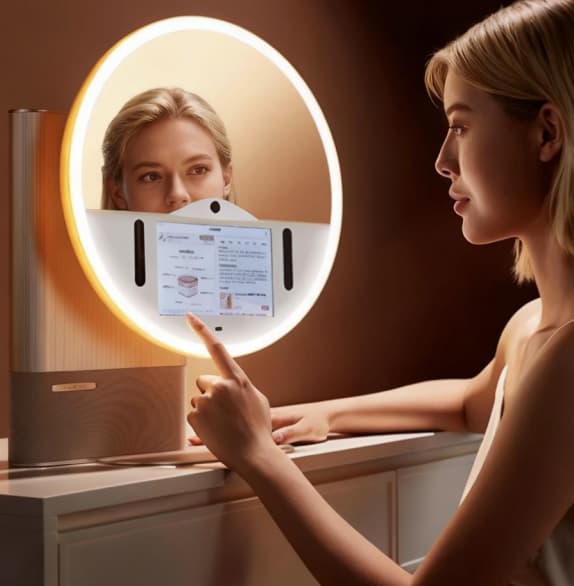
It looks professional without looking intimidating.
For a solo beauty therapist, skin specialist, salon owner or clinic, I think it's a really practical piece of equipment. It's neat, easy to use and, in my opinion, excellent value for what it offers.
What does the AI skin mirror detect?
The AI skin mirror detects eight key skin concerns:
Wrinkles
Pores
Pigmentation
Superficial pigmentation or visible skin spots
Sensitivity
Acne
Blackheads
Dark circles
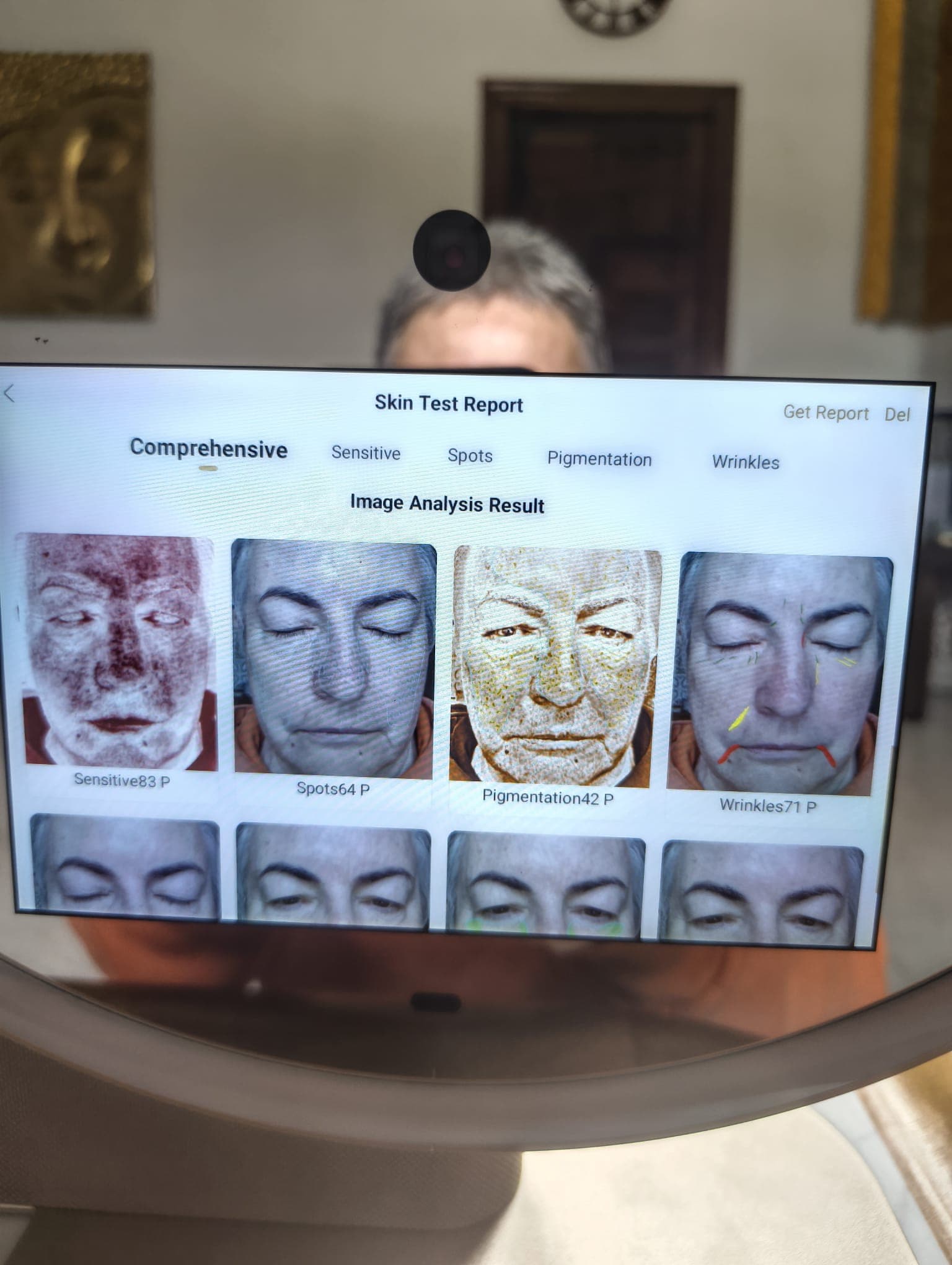
The system uses image-based AI skin analysis to create a professional skin test report. You can either do a quick snapshot, which captures the front view of the face, or you can do a fuller report with the front, left side and right side of the face.
The actual skin scan is very quick. In all honesty, the longest part is usually switching the machine on and getting the client’s face lined up correctly.
Once the face is positioned, the AI skin analysis report is generated quickly and gives a clear breakdown of what is showing on the skin.
It shows the areas of concern, the level of severity, visual markers on the face, and product or treatment recommendations if you have set those up in the system.
AI skin analysis does not replace the therapist
This is the part I feel strongly about.
AI skin analysis is a brilliant tool, but it does not replace the therapist.
It does not replace proper consultation skills.
It does not replace skin knowledge.
It does not replace professional judgement.
It does not replace the ability to explain what is happening in plain English.
What it does do is give the therapist and the client a much clearer visual starting point.
The machine may detect pigmentation, but the therapist still needs to understand what type of pigmentation they may be looking at.
The machine may identify sensitivity, but the therapist still needs to ask about barrier function, skincare use, allergies, medication, recent treatments, inflammation, irritation and contraindications.
The machine may show acne, blackheads or congestion, but the therapist still needs to understand oil production, comedones, papules, pustules, nodules, cystic acne, hormones, lifestyle factors and referral boundaries.
The machine may show wrinkles, but the therapist still needs to explain ageing, collagen, elastin, dehydration, UV damage, lifestyle and realistic treatment outcomes.
So no, AI is not here to make therapists lazy!!
If anything, AI skin analysis exposes the therapist’s level of knowledge.
Because once the client can see the issue on the screen, they're going to ask the obvious question: “What do I do about it?”
And that is where proper training matters.
Why AI skin analysis makes consultations stronger
One of the biggest benefits of the AI skin mirror is that it makes the consultation more visual.
As therapists, we often see things that the client doesn't fully understand. We may notice dehydration, pigmentation, congestion, sensitivity, barrier damage, fine lines, enlarged pores or signs of sun exposure.
But saying something and showing something are two different things.
For example, many clients know they should wear SPF every day. They have heard it before. They know the lecture is coming.
But when they can actually see pigmentation damage on their own skin analysis images, the conversation changes.
It's no longer me saying, “You really should wear SPF.”
It becomes, “This is why SPF matters for your skin.”
That's a much stronger consultation.
It feels more educational and less salesy.
That matters because many therapists struggle with retail recommendations. They worry about being pushy. They worry the client will think they're only trying to sell them something.
But when your recommendation is linked to what the client can clearly see in their own skin analysis report, it becomes professional advice.
Not pressure.
Not guesswork.
Professional advice.
The impact on SPF and retail sales
One of the most noticeable things for me has been how the AI skin mirror has helped clients understand the importance of SPF.
Here in Spain, I have sometimes found it a struggle to get clients to invest properly in SPF. Strange as it may sound, people will spend money on treatments but then hesitate over daily sun protection.
However, since using the AI skin mirror and showing clients the visible pigmentation and sun damage, SPF has been flying off my shelves.
That's a perfect example of how good consultation supports retail.
I haven't suddenly become more pushy.
The client can simply see why the recommendation matters.
This is where I think AI skin analysis can be incredibly valuable for beauty therapists, skin specialists and salon owners. It helps connect the client’s concern with a clear product or treatment recommendation.
If the report shows pigmentation, SPF and pigmentation-supporting skincare make sense.
If it shows sensitivity, barrier repair makes sense.
If it shows congestion or blackheads, appropriate cleansing, exfoliation and pore support make sense.
If it shows dehydration and fine lines, hydration and barrier-supportive skincare make sense.
The therapist still needs to know how to explain it, but the visual report makes the conversation much easier.
Personalised treatment and product recommendations
Another feature I really like is that you can add your own treatments and products into the system.
The treatments are added under what the system calls skincare projects.
You can include your treatment name, price, images, before and afters, the recommended reason for suggesting the treatment, and a full treatment description.
For example, you can include:
- Who the treatment is suitable for
- What skin concerns it supports
- What homecare may be needed
- What the client should avoid before treatment
- What aftercare is required
- Who the treatment is not suitable for
- Any key contraindications or cautions
You can also add your skincare products.
For each product, you can include the product image, price, main indication, product subtitle, recommended reason, key ingredients and benefits, and instructions for use.
The main skin indications available in the system include wrinkles, pores, pigmentation, superficial pigmentation or spots, sensitivity, acne, blackheads and dark circles.
There are some limitations because you're working with the indications available in the system, but there are ways to work around this by using the wording in your product and treatment descriptions properly.
My honest advice: map it out first
This is my biggest practical tip if you decide to use an AI skin analysis system.
Do not do what I did at first and just start merrily plugging everything in.
Map it out first.
Sit down and plan:
- Which treatments link to each skin concern
- Which products support each concern
- What your treatment descriptions will say
- What your recommended reasons will be
- What images you need
- What prices you want to show
- What before and afters are appropriate
- What homecare advice is needed
- What contraindications should be included
- What pre-treatment advice should be shown
- What aftercare advice should be included
I started adding products and treatments, then quickly realised I needed more of a system.
Once I had that structure, it became much easier.
Adding each product or treatment doesn't take long once you know what you're putting in. But the planning makes the report look much more professional and useful to the client.
It also forces you to look properly at your own treatment menu and product range.
And quite honestly, that's not a bad thing.
Sometimes the technology highlights where your own systems need tightening up.
AI skin analysis and treatment planning
One of the things I like most about the AI Skin Detection Mirror is that it supports better treatment planning.
Instead of offering isolated treatments with no clear direction, you can use the analysis to build a more professional skin journey.
For example, if the analysis highlights pigmentation, pores and sensitivity, you may need to think carefully about the order of treatment.
Does the skin barrier need support first?
Is the client using SPF properly?
Is pigmentation work appropriate yet?
Are they using products that are irritating the skin?
Would a course of treatments be more effective than a one-off facial?
When should you reassess the skin?
This is where a therapist moves from simply “doing facials” to creating proper skin programmes.
And that's a professional shift the industry needs.
Clients don't just want random treatments anymore. They want results, clarity and a plan.
AI skin analysis can help support that, but the therapist still needs the training and confidence to interpret what is showing and recommend the next step.
Tracking before and after results
Another useful part of the AI skin mirror is the ability to store client records within the skin analysis software.
This means you can track the client’s skin over time.
You can take the first images before starting a course of treatments, then repeat the analysis later to show progress.
This is useful for concerns such as:
- Pigmentation
- Large pores
- Congestion
- Blackheads
- Acne-prone skin
- Texture
- Fine lines
- Sensitivity
- Dark circles
- Dullness
Clients often don't notice gradual improvements because they see their own face every day. But when they can compare images from the start of their journey to later images, the changes are easier to see.
This helps build trust.
It also helps clients stay committed.
But again, this requires proper communication from the therapist. You need to explain that skin improvement takes time. Pigmentation can be slow. Acne can fluctuate. Sensitivity needs careful handling. Ageing skin can improve in quality, hydration and firmness, but no facial is going to magically turn back the clock by thirty years.
And if anyone tells you otherwise, run for the hills.
AI skin analysis and beauty training
From a beauty training perspective, I think AI skin analysis opens up an important conversation.
Technology is moving quickly.
Clients are becoming more educated.
Skin treatments are becoming more advanced.
Retail needs to become more professional.
Consultations need to become more thorough.
And therapists need to understand that buying a machine doesn't automatically make them more skilled.
A skin scanner, AI mirror or skin analysis device is only as effective as the professional using it.
If you cannot explain the skin, interpret the findings, recommend the right homecare, identify contraindications, manage expectations and know when to refer, the machine will not fix that.
In fact, it may make the gaps more obvious.
This is why I believe consultation skills, skin analysis, product knowledge, treatment planning and retail confidence should be taken far more seriously in beauty training.
They are not optional extras.
They are core professional skills.
Is an AI skin mirror worth it for beauty therapists and salons?
In my opinion, yes - if you're going to use it properly.
An AI skin mirror could be a strong investment for:
- Solo beauty therapists
- Skin specialists
- Facialists
- Salon owners
- Aesthetic clinics
- Advanced skincare therapists
- Training academies
- Therapists wanting stronger consultation systems
- Therapists wanting to improve retail recommendations
- Therapists wanting to track client progress
But I would be very clear on this.
Do not buy one because it looks impressive.
Buy one because you're serious about improving your consultations, educating your clients, strengthening your treatment planning and making your recommendations more professional.
Used properly, AI skin analysis can help you:
- Create more professional consultations
- Educate clients more clearly
- Show visible skin concerns
- Support SPF and skincare recommendations
- Improve treatment planning
- Track before and after progress
- Increase client confidence
- Improve retail conversations
- Differentiate your salon or clinic
That's where the real value is.
My final thoughts on the AI Skin Detection Mirror
Overall, I'm genuinely very pleased with the AI skin mirror.
The service from Louisa Webb was excellent. The delivery was faster than expected. The equipment was beautifully packaged, professional-looking, compact and easy to use.
The system detects eight key skin concerns and creates a professional skin analysis report quickly. It allows client records to be stored, progress to be tracked, and personalised product and treatment recommendations to be added.
For me, the biggest benefit isn't just the technology itself.
It's the conversation it creates.
It helps clients understand their skin.
It helps therapists explain their recommendations.
It helps make retail feel like professional advice rather than awkward selling.
It supports treatment planning.
It gives clients a clearer reason to commit to homecare, SPF and a proper skin journey.
But the therapist still matters.
AI can show the data.
The therapist has to create meaning from it.
And that is why, as the beauty industry continues to move forward, professional training, consultation skills and skin knowledge are going to matter more than ever.
Interested in the AI Skin Detection Mirror?
If you're a beauty therapist, skin specialist, salon owner or trainer and you are interested in finding out more about the AI skin mirror I have purchased, you can contact me and I can point you in the right direction. Click here to send me an email
As mentioned earlier, I may receive a referral commission if you decide to buy through my recommendation. I am happy to be upfront about that.
But I would only recommend it if I genuinely believed it had value.
And having used it myself, I can honestly say I think it's a brilliant tool for therapists who want to take their consultations, skin analysis and treatment planning more seriously.
Because AI skin analysis is not about replacing the therapist.
It's about helping a well-trained therapist do an even better job.
And that is exactly where the beauty industry needs to go.